Two sentences, two hours, a signed train.
A case study from Saphan Studio running Saphan’s own engineering. On 30 October 2026 the approver, the engineering lead accountable for the work, asked the agents, in a few sentences, for deterministic integrations with the standard tools of CI/CD. About two hours later the approver read and signed a plan of thirteen work packages, each with a definition of done a test must prove. Ten minutes after the signature, the first one was running. This case study follows that feature from idea to running work, using only what the record holds.
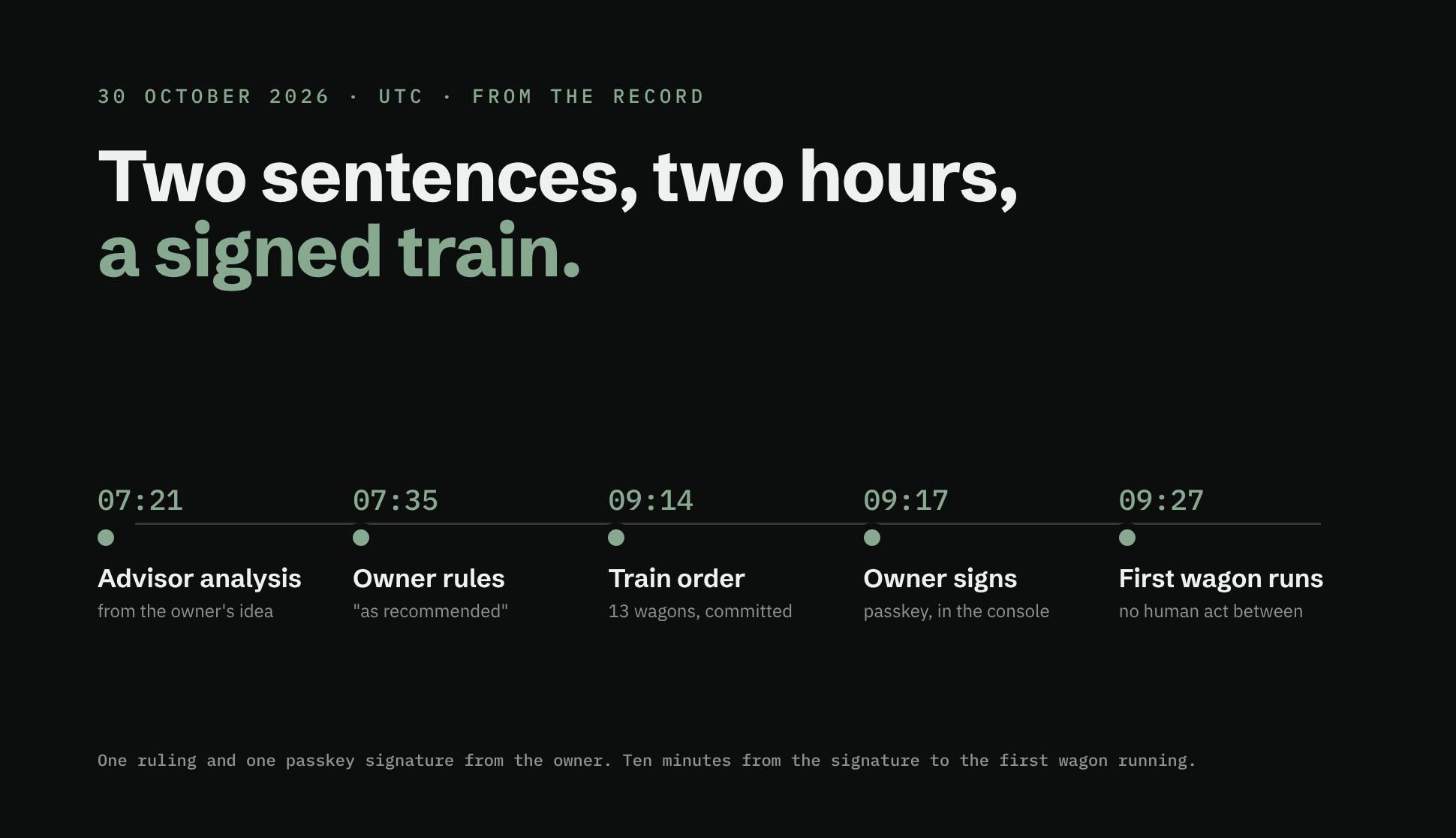
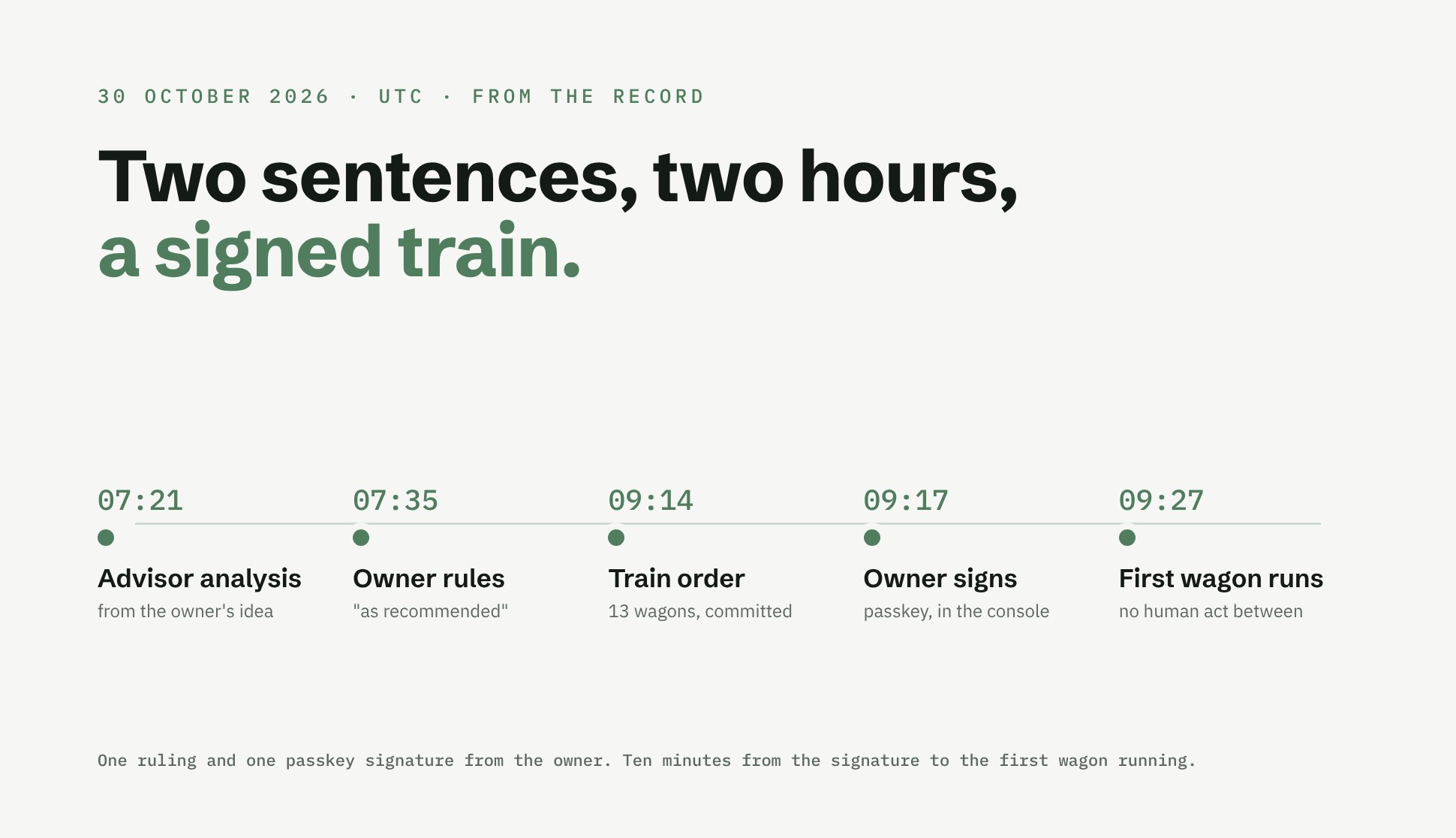
The timeline, in UTC
| Time | Who | What happened |
|---|---|---|
| 07:21 | Advisor | An analysis of the approver's intent: about 50 tools in 12 classes, a tiered design and four decisions. |
| 07:35 | Approver | Rules on all four: "as recommended". |
| 09:14 | Master | Commits the train order: 13 wagons, readings to refute, routing, definition of done, questions. |
| 09:17 | Approver | Reads the order in the console and signs it with a passkey. |
| 09:27 | Master | Verifies the signature again and places the first wagon on a build machine. |
What the train builds
Pre-configured skills for the tools your teams already use
Test runners, dependency and secret scanners, OWASP tools, SBOM and signing tools. An agent asks Saphan Studio for the exact, pinned, tested way to run a tool on the repository in hand, instead of improvising a command.
A deterministic runner
It runs the recorded command, normalises the result to SARIF, JUnit or CycloneDX, compares it with the last run and reports it to Tests Studio. The model sees only what changed.
A conformance gate in code
A tool enters the catalogue only by passing a gate: pinned by digest, run on a fixture with a known outcome, output checked against its schema, and the network it reached compared with the network it declared.
One order, one agent, one new tool
Once the wiring is tested, adding a tool is a single order: "analyse tool X and add it to the library". It is not a new product: it is one more use case on the same Saphan Studio core.
Where the human comes in
One signature for the whole train
The approver signs the train once, in the console, after "Review what you will sign". The signed text is every byte of the order, and it opens with the approver's own words, verbatim.
The agents work alone inside the boundary
The master signs its own work orders, sends fix rounds after reviews and moves work when a machine dies. Review is never the author's own.
The boundary is code, not good intentions
Budget, the list of wagons, repositories, outbound network and landing on the main line are enforced by the system. Scope inside a wagon, licences and another team's track are the master's rules, and the case study says which is which.
Landing always comes back to a person
An agent cannot type the approver's confirmation. Every irreversible step waits for a person.
Bring your own agents
Claude Code, Codex, Cursor's agent, Qwen Code, Cursor and Droid run under Saphan Studio today, next to our own agent loop, which runs NVIDIA Nemotron. The coding can run on the agents a team already pays for. Orchestration, governance, security (grants per task, outbound network closed by default) and the record stay in Saphan Studio.
Inside the PDF
32 pages, written for five readers: an executive summary, and chapters for the product manager, the architect, the QA engineer, and the reviewer and tester. It includes screens from the CLI and the console, excerpts from the signed train order, a table of when the master must come back to a person and whether code or a rule stops it, and the security events of the same week. Key identifiers, amounts, personal names and machine names are masked.
What this does not claim
The train has not finished.
This case covers the planning, the signature and the start. The build, its reviews and its tester are still ahead.
It is written from the record.
Times come from file timestamps, commits and the console, and the delegation chapter from the advisor's written answer. Where the record corrected us, we used the record.
Check the work yourself
To judge the code agents produce under Saphan Studio, start with the last full build: Proven at its measured tag and its effort report. Run your own coverage, static analysis and complexity tools on it.
More of Saphan Studio
Research — study AI agents at work →Governance — decisions on the record →Protocol — how the agents work →
Want to see the same flow on your own tools and repositories?
Contact us — [email protected]